Roles and Responsibilities: Participating Institute
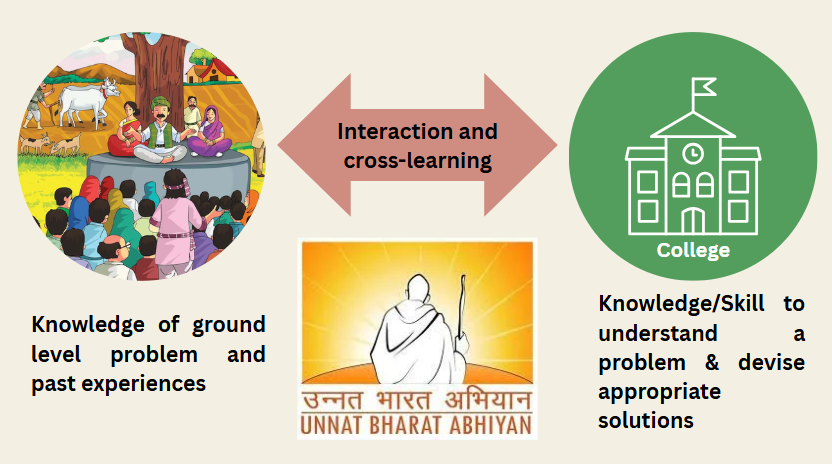
All Participating Institutions (PIs) are required to establish a UBA Cell, responsible for implementing the activities of the Unnat Bharat Abhiyan (UBA). This involves creating an active working group of motivated faculty members from various disciplines. To guide and monitor the activities of the UBA Cell in each institution, an Executive Committee and a local advisory committee, chaired by the Head of the Institution, is established. Any Higher Educational Institution (HEI) interested in collaborating with Unnat Bharat Abhiyan can join the program by applying online through the UBA website. The responsibilities of Participating Institutions (PIs) include :
- Village Identification: It is mandatory for each PI to identify and select five villages in consultation with the District Collectors for activities under UBA.
- Field Studies and Scheme Implementation: Institutions are expected to conduct field studies, examine the implementation of government schemes, and facilitate their effective execution to ensure that they achieve their intended objectives.
- Faculty and Student Engagement: PIs should involve interested faculty members, students, NSS, and other bodies within the institution that are engaged in community development activities.
- Collaboration for Solutions: Selected PIs will collaborate with state government, district authorities, Panchayati Raj Institutions (PRIs), other institutions, and non-governmental bodies to develop suitable solutions for enhancing the social and economic well-being of rural communities.
- Engaging Students: The PI should involve more and more students’ year after year in UBA programs.
- Developing Linkages: Establish connections with selected rural clusters, engage in the planning process, and promote necessary Science and Technology (S&T) interventions to enhance and accelerate development efforts in those clusters.
- Competence Development: PI enhances the competence of the working group through appropriate orientation, training, and fostering a culture within the institution that supports indigenous and sustainable rural development. This includes initiating necessary curricular modifications and other facilitating measures.