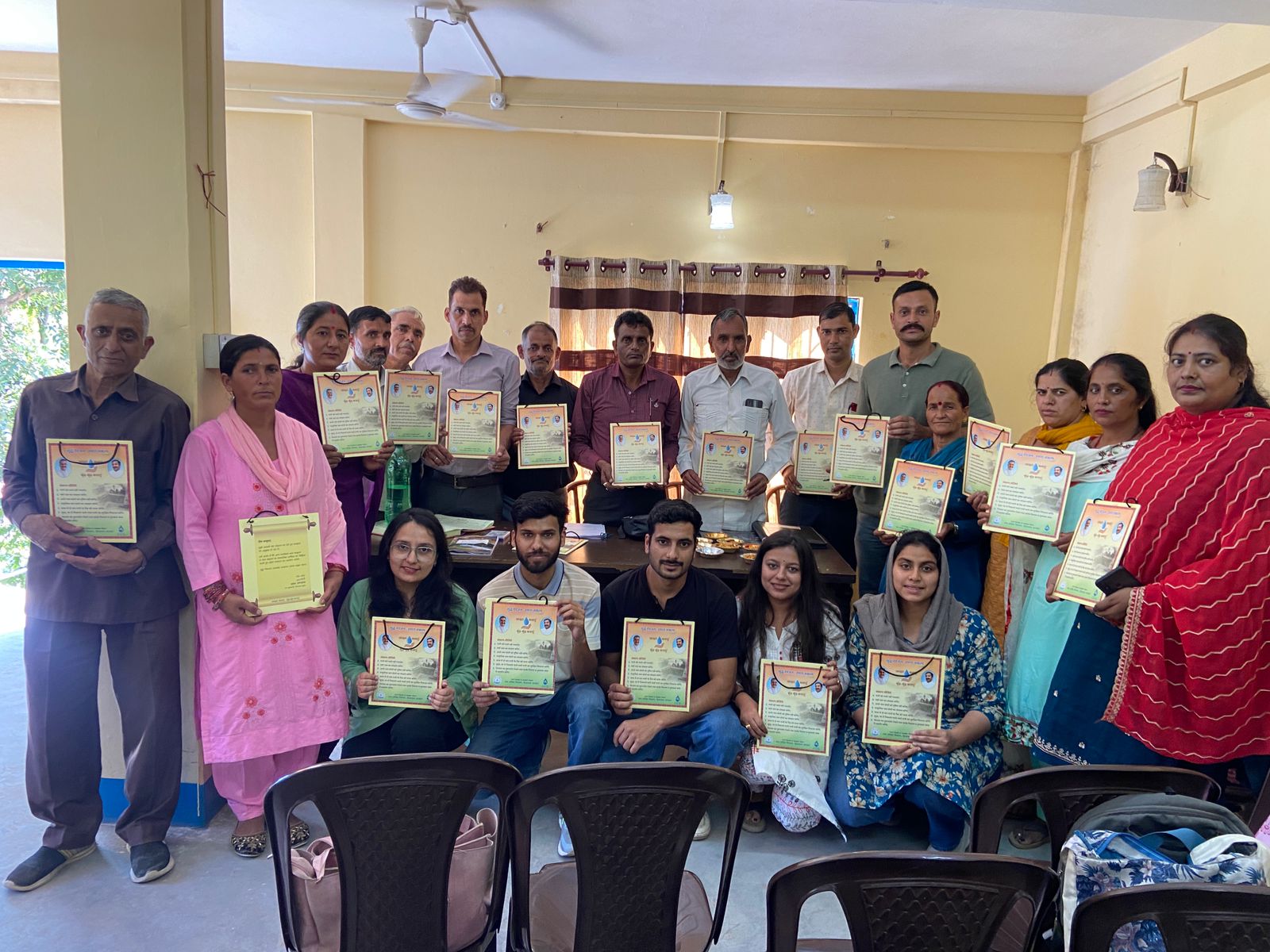
Students of Dr YS Parmar University of Horticulture and Forestry Nauni Solan participating in Gram Sabha meeting on People's Plan Campaign for GPDP
Unnat Bharat Abhiyan (UBA) is a flagship program launched by the Government of India,
aimed at connecting institutions of higher education with rural communities to address the
development challenges faced by these areas. The initiative seeks to harness the knowledge,
expertise, and technological innovations of institutions like IITs, NITs, and other universities
to find sustainable solutions for rural development.
The primary goal of UBA is to improve the quality of life in villages by fostering a
collaborative approach between academic institutions and local communities. It promotes the
implementation of technologies, resources, and skills that can enhance areas such as water
management, renewable energy, organic farming, health, and education. UBA also emphasizes
empowering Gram Panchayats and strengthening the rural economy through the adoption of
best practices and efficient resource management. The initiative aims to create a synergy
between rural India and the knowledge base of urban educational institutions, contributing to
the overall development of the country. IIT Delhi, in collaboration with the Ministry of
Panchayat Raj, has taken steps to involve students in grassroots planning processes as part of
the People’s Plan Campaign (PPC), which launched on 2nd October 2024. The campaign
encourages student participation in the preparation of Gram Panchayat Development Plans
(GPDPs), helping to create more impactful and community-focused development strategies.
As part of this initiative, we, the students of the UBA cell at Dr. Y S Parmar University of
Horticulture and Forestry, Solan, Himachal Pradesh—Kajal Sharma, Kartike Sharma, Fathima
Rani, Joyti Poddar, and Abhishek Sharma—visited Gram Panchayat Shamrod on 2nd October
2024. Our objective was to gather essential data and information to assist the Panchayat in
preparing its GPDP. This initiative will foster a deeper connection between academic
institutions and rural governance while ensuring that the development plans reflect the needs
and aspirations of the local communities.